Kako Foam Roller Spreadsheet Guide
Kako Foam Roller Spreadsheet Guide
Kako Foam Roller Spreadsheet Guide: Filter by Relaxation Area, Hardness Cues, and Size
The real difficulty in choosing a foam roller is not finding the one that looks most professional, but matching the relaxation area, available space, size, and structural information that the page can prove. This guide helps you build a reviewable comparison checklist when browsing candidate products on kako-spreadsheet.com, and eliminate entries with unclear specifications or insufficient evidence before placing an order.
This article is suitable for buyers who are willing to check product pages, images, and specification text. It is not suitable for those who need medical diagnosis, post-injury rehabilitation plans, or personalized pain management. Persistent pain, obvious swelling, numbness, or recent injury should first be evaluated by a qualified medical professional.
The baseline date for dynamic product information verification is September 3, 2026. Since this article does not have access to real-time prices, inventory, material certifications, weight capacity tests, or seller commitments for specific products, these fields must be re-verified on the actual purchase date. The sample judgments in this article should not be treated as product facts.
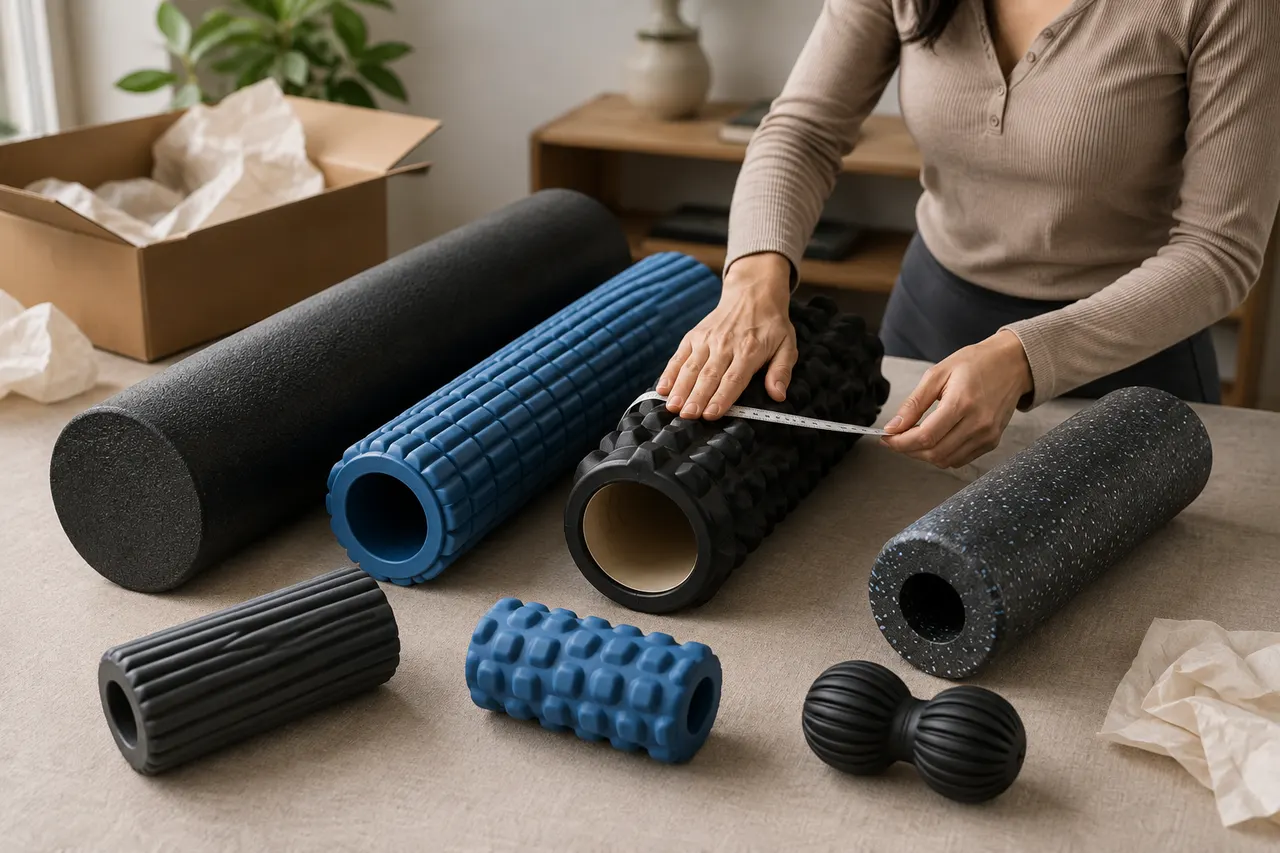
Determine the Selection Range from Target Muscle Groups and Usage Space
First write down the main purpose, then open the product list. 🎯 If the goal is large-area rolling of the legs, prioritize comparing lengths and diameters that provide stable contact area; if mainly targeting the soles of the feet, outer calves, or localized gluteal areas, you can keep shorter, easier-to-position candidates. For back use, also consider whether your body can be stably supported on the roller, rather than just looking at the "back" label in the product name.
Also measure the actual usage space:
Available floor width, and the extra room needed for body movement forward and backward during rolling
Internal dimensions of storage cabinets, suitcases, or gym bags
Whether the roller will be used stationary at home, or often carried around
Whether the floor is even, and whether an anti-slip mat is needed
This step only determines the filtering range; it does not judge which size is necessarily more comfortable. Comfort is influenced by movement, contact area, duration of use, and personal sensitivity, and usually cannot be directly proven by the product page.
Use the Kako Spreadsheet to Build a Foam Roller Comparison Checklist
After seeing candidate entries on kako-spreadsheet.com, don't just save the product name or main image. 📋 For each candidate, go back to the corresponding product page to verify, and record the specifications shown on the page at that time. If the checklist summary does not match the product page, mark the discrepancy as "to be confirmed" instead of arbitrarily choosing a number.
Comparison Field | What to Record | Action When Evidence Is Insufficient |
|---|---|---|
Page Identity | Product name, entry identifier, verification date | Exclude if it cannot be matched to the same product |
Dimensions | Length, diameter, units | Mark as unknown if only estimated from images |
Surface Structure | Smooth, textured (bumps), or zoned, and visible form | Contact seller if text and images conflict |
Construction | Solid, hollow, or not stated on page | Do not guess from end-face shadows |
Density or Hardness | Original page wording and applicable conditions | Do not convert marketing terms into hardness levels |
Transaction Information | Price on that day, stock, specification options, return/exchange terms | Re-verify before ordering |
Total Cost | Product price, domestic shipping, international shipping, possible taxes | Do not conclude lowest price if any component is missing |
If two color options correspond to different sizes or constructions, split them into separate rows. This avoids mistakenly combining the image of one style, the price of another, and the specifications of a third into a non-existent combination.
Choose Size by Back, Leg, and Localized Relaxation
Size selection should revolve around contact range and control method, not a one-size-fits-all answer.
Back: Record whether the roller length covers the planned contact area, and confirm movement space. If the page lacks dimensions, do not judge based solely on model proportions.
Legs: Compare the contact width needed for thigh and calf rolling. Longer rollers may cover wider areas more easily, but also increase storage footprint.
Localized relaxation: Shorter rollers are usually easier to fit in limited spaces, but have smaller contact area; movement stability still needs to be checked upon receipt.
Diameter also needs to be recorded separately. A larger diameter changes the body's height above the ground and rolling trajectory, while a smaller diameter may concentrate pressure in a narrower range. If the page does not provide diameter, treat it as a critical missing specification, not minor information.
Distinguish Smooth, Textured, and Zoned Surface Structures
Smooth, textured, and zoned textures can be classified visually from clear images, but visual classification does not equal tactile conclusions. 🧩
Smooth rollers usually have a more continuous visible contact surface; textured rollers require recording the shape, spacing, and arrangement of bumps; zoned rollers should specify which areas of the roller have different textures. If the image only shows one angle, do not assume the back has the same structure.
Terms like "deep tissue" or "massage-level" alone cannot prove pressure intensity. Only when the page provides clear structure, dimensions, or material information can these be included in comparison. For sensitive areas or first-time users, it is safer to keep candidates with clear return/exchange terms and complete specification descriptions, rather than chasing the most extreme texture.
How to Cautiously Interpret Density and Hardness Labels
Words like "soft," "medium," "hard," or "high density" lack a unified scale and should only be considered as seller or page labels. Even if different products use the same word, they may not represent the same compression performance.
When building a comparison checklist, record these words verbatim, and also look for verifiable material names, density values, test methods, or model descriptions. If the page has no quantitative basis, write hardness as "page claimed, not independently verified." Do not derive hardness from color, weight, price, or surface texture.
For two products that both only say "high density," the reasonable conclusion is that they cannot be reliably ranked by hardness at this time. Instead, compare completeness of dimensions, image clarity, specification consistency, and return/exchange terms.
Check Surface Seams, End Faces, and Hollow Construction from Images
Product images are suitable for checking visible structure, not for proving durability. 🔍 It is recommended to view in order:
Full view of the roller, confirm overall straightness and texture continuity.
Close-up of the surface, observe any visible seams and their locations.
Both end faces, check whether open holes, inner core, or closed construction are shown.
Dimension diagram, confirm units and correspondence of length, width, diameter.
Images of different specification options, avoid recording the structure of another model for the current option.
Shadows, shooting angles, and post-processing can affect judgment. If the image does not show the end face, record "end face not visible"; seeing a circular outline does not automatically mean hollow. If page images conflict with text specifications, pause final ranking of that candidate.
Mark Comfort and Weight Capacity Claims Not Provable by Page
The following conclusions usually cannot be verified solely by title, main image, or marketing text:
Whether long-term use is comfortable
Whether it suits all body weights or fitness levels
Whether bumps provide specific relaxation effects
Whether the inner core does not deform over time
Whether the surface is wear-resistant, odor-free, or easy to clean
Whether the product can treat pain or improve specific conditions
You can set three statuses in the checklist: "proven," "page claimed," and "unknown." Only content directly supported by dimension diagrams, specification text, or clear product images goes into "proven"; seller adjectives go into "page claimed"; experience, durability, and weight capacity judgments lacking evidence go into "unknown." This classification keeps low-priced but information-ambiguous products with appropriate uncertainty.
Confirm Specifications Before Purchase and Set Up Receipt Inspection Steps
Before payment, re-confirm the selected size, color, surface structure, quantity, price, stock status, and return/exchange terms on the specific product page. 📦 Also record the verification date and save screenshots of the specification page without personal payment information. International shipping costs, taxes, and route restrictions vary with destination country, package data, and current policies. Use the latest information from checkout and carrier stages, declare the product truthfully, and do not use under-declaration or methods to evade inspection.
After receiving warehouse inspection photos or the actual product, you can review in the following order:
Check that color, quantity, and style match the order.
Request size reference or use a measuring tool to confirm length and diameter.
Check for surface damage, obvious delamination, or severe deformation.
Check that end faces match the structure shown on the page.
For hollow rollers, check for visible cracks or significant eccentricity in the inner core.
Handle specification errors or visible defects within the return/exchange window.
If warehouse photos have no scale reference, do not claim dimensions have been verified. If defect locations are unclear, request clearer photos before deciding to return/exchange or ship.
The final choice should not be summarized as "the cheapest one." Calculable savings should be the complete total cost of the original candidate minus the complete total cost of the final choice; if international shipping, taxes, or specification-specific prices are missing, mark as "not calculable at this time." Choosing a shorter or simpler construction may reduce product price or shipping space, but also increases risks of insufficient coverage, unsuitable specifications, or incomplete information.
This filtering method is suitable for buyers willing to measure space, verify page evidence item by item, and re-inspect at receipt. It is not recommended to choose products with missing dimensions, unclear hardness meanings, images not matching specific specifications, or unclear return/exchange terms just for a small price difference; if the main need involves pain management, do not replace professional medical evaluation with foam roller product filtering.
This article was compiled by the automated editorial process of the Panda-Buy Editorial Desk, using clear evidence grading and pre-purchase review methods. It does not represent real purchase, touch, use, or medical testing by a person.
Browse our latest products and find your next favorite item.